|
PATHOPHYSIOLOGY OF BIT CONTROL IN
THE HORSE
W. Robert Cook FRCVS., Ph.D.,
You may contact Dr. Cook at (410)
778-9005 or
e-mail drcook@bitlessbridle.com.
SUMMARY
The use of one and often two bits,
in traditional or normal horsemanship, constitutes a
welfare problem, a hazard to health, and a handicap to
performance.
-
The bit method of control is
invasive, physiologically contraindicated and
counter-productive
-
A bit often causes discomfort,
pain and injury
-
It can be responsible for a
horse’s poor attitude to exercise and many behavioral problems
in all types of equitation from dressage (eg., headshaking) to
racing (eg., dorsal displacement of the soft palate). Horses
are happier in a bridle without a bit
-
The bit can be the sole cause of
abnormal inspiratory noise (stridor) at exercise
-
To govern the speed of a
racehorse using a bit and traction on both reins depends on
poll flexion, which obstructs the airway and leads to
premature fatigue, poor performance, and asphyxia-induced
pulmonary edema ("bleeding"). Measurement of jowl angle is
recommended as an indicator of upper airway patency
-
A bit triggers digestive tract
reflexes, which are physiologically opposed to rapid breathing
Horses are being expected to eat and exercise
simultaneously, two activities that are mutually exclusive
-
As the bit interferes with
breathing and as breathing is coupled with locomotion, the bit
also interferes with locomotion
-
A horse that leans on the bit
loses self-carriage, and becomes heavier on the forehand. Its
stride becomes shorter and, therefore, slower. In addition,
greater stress is placed on the tendons, ligaments, joints and
bones of the forelegs. In racing, this factor coupled with
premature fatigue from whatever cause, renders breakdowns and
fatal accidents more likely
-
Resistance to the bit causes
rigidity of the neck, which is incompatible with optimum
performance. It reduces the effectiveness of some important
energy conservation mechanisms. Human athletes need complete
freedom of the neck
-
The horse is an obligatory
nose-breather. At exercise, a horse’s lips should be sealed
and mouth closed so that no air enters the digestive tract. A
bit breaks this seal and the mouth is often open
-
"Non-acceptance of the bit"
includes problems such as buccal ulcers, wolf tooth
sensitivity, pain during eruption of cheek teeth, star
fractures of the mandible, lacerations of the lip, tongue and
gingiva, open mouth, tongue movement, tongue behind the bit,
tongue over the bit, ‘swallowing the tongue’, ‘flipping the
palate’, headshaking, fighting the bit, chewing on the bit,
‘bit between the teeth’, veering, boring and pulling
-
The safety of rider and horse
are imperiled when justifiable resentment of bit-induced pain,
leads a horse to take the bit between its teeth and bolt
In the practice of natural
horsemanship, horses can be controlled for early schooling
without a bit, and for advanced schooling with a snaffle. In
this way, the above problems can be either solved or minimized,
respectively. A new design of bitless bridle, that is neither a
hackamore nor a bosal, permits control by painless pressure on
the skin behind the ear. It facilitates the humane, non-invasive
and natural approach, and is applicable to both early and
advanced schooling.
INTRODUCTION
In the practice of normal
horsemanship, man has applied his greatest force at one of the
most sensitive parts of the horse…its mouth. We have grown so
accustomed to the bit method of control that its major
physiological disadvantages have passed unrecognized. The bit
constitutes an invasive method of control, for a body cavity is
violated. Lack of awareness of an alternative has been a factor
in the bit’s long tenure. The objective of this article is to
draw attention to the acceptable alternative of natural
horsemanship.
The following criticisms of the
bit apply particularly to its traditional usage in normal
horsemanship. In this mode, it is customary to use one or more
bits (often of significant weight and considerable severity) to
govern a horse’s speed by simultaneous traction (often of many
pounds psi) on both reins simultaneously. Poll flexion is a
significant part of control and bit pressure is often maintained
over long periods. In addition, many riders use the reins as an
aid to balancing in their seat.
In natural horsemanship,
control can be achieved non-invasively, without a bit. But, when
a bit is used it is confined to a snaffle, bit pressure is
transient and limited to 4 oz psi. from one rein at a time; poll
flexion is minimal and the rider has an independent seat1.
Under these conditions, a bit is less harmful but still
contraindicated.
PHYSIOLOGICAL AIRFLOW AT EXERCISE
IN THE HORSE AT LIBERTY
The atlanto-occipital joint can be
thought of as a respiratory joint, as its position
governs airflow. Movement of the joint is limited to flexion and
extension. Its position correlates with jowl angle; the angle
between the horizontal ramus of the mandible and the ventral
line of the neck. Full extension of the atlanto-occipital joint
corresponds to a jowl angle in the region of 150°, full flexion
to about 30° and a neutral position to about 90°.
-
Full extension .
When galloping at liberty and at maximum speed, the horse’s
head and neck should, I believe, straighten out - like a swan
in flight - and the horizontal ramus of the mandible come to
lie almost parallel to the ground (Fig 1a and 2a).
-
Full flexion.
This position is unlikely to occur in the wild except
transiently, as it is only suitable for quiet breathing. The
nasal bone is vertical to the ground and the nasopharynx is
maximally obstructed (Fig 1b, 2d and 3c).
-
Neutral. .
The position adopted when at rest with head erect and
breathing slowly (Fig 2b,4a), or when walking (Fig 1a: inset).
With the aid of photography, jowl
angle is an external and measurable indicator of the patency of
the upper airway at exercise. It is a parameter that, in the
past, we have overlooked and failed to document.
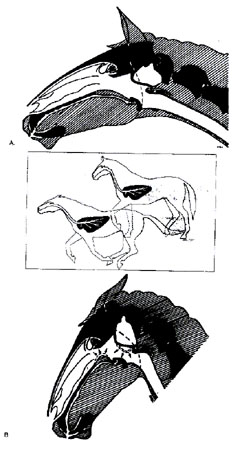
Fig 1. Showing the correlation
between patency of the upper airway and the atlanto-occipital
joint.
Key: Dense black areas = bone or
cartilage; cross-hatched areas = soft tissues
-
Full poll extension
(jowl angle 140°): The airway is fully patent (Fig 2a
corresponds with this diagram). The soft tissue boundaries of
the nasopharynx are stretched longitudinally, which helps them
resist the otherwise collapsing force of inspiration.
Inset: Showing the entire airway
at rest and its swan-like straightening at exercise
-
Partial poll flexion
(jowl angle 70°): The airway is sharply bent and seriously
obstructed. The soft tissues of the pharynx further collapse
into the airway (see broken lines) during inspiration. This
diagram corresponds to Fig 2d. If, as in dressage, the horse
works with its nasal bone vertical to the ground (Fig 3c: full
flexion) or, even worse, behind the vertical (‘overbent’), the
degree of airway obstruction would be even more severe.
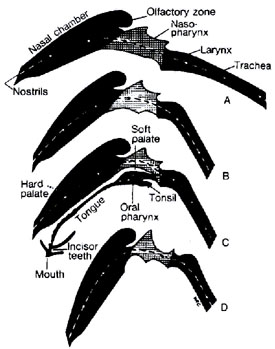
Fig 2. Showing the shape of the
upper airway with the atlanto-occipital joint in three different
positions (a, b, & d). The diagrams are based on radiographs of
the same fully conscious horse with its head in the three basic
positions. The nasopharynx is cross-hatched and the squares have
been counted in each of the diagrams to measure the percentage
reduction in sagittal section area that occurs as full extension
is lost. As a measure of the logarithmic increase in airway
resistance that accompanies reduction in cross-sectional area,
the sagittal section area percentages grossly underestimate the
problem but they offer a rough reminder.
-
Full poll extension :
This airway corresponds to that shown in Fig 1a (jowl angle
140°). The nasopharynx is unobstructed and the area
measurement is taken as representing 100%. The soft palate and
epiglottis form a nearly level floor to the nasopharynx. The
posterior nares are fully patent.
-
Neutral position of the poll :
This airway corresponds to that shown in figure 4a (jowl angle
87°). The nasopharyngeal area is 90% of what it is when fully
extended. This obstruction, therefore, represents a serious
handicap for a racehorse.
-
Neutral position with dorsal
displacement of the soft palate ;
The nasopharyngeal area is 43% of potential and is severely
obstructed. A bottleneck occurs at the posterior nares and
leads to a cascade effect. The abnormally negative pressure on
inspiration in the nasopharynx, increases further at every
subsequent section of the airway between here and the lungs,.
In the nasopharynx, the negative pressure can cause the soft
palate to rise even further and make contact with the roof of
the nasopharynx, plugging the airway completely and causing
the horse to choke. In the small airways of the lungs, where
the negative pressure is at its most intense, it leads to
asphyxia-induced pulmonary edema and so-called ‘hemorrhage’.4
Partial poll flexion: This
airway corresponds to that shown in Fig 1b (jowl angle 70°). The
nasopharyngeal area is 53% and, accordingly, inspiratory
resistance is much more than doubled. The diameter of each
posterior nares is probably halved. The airway will be at risk
for the same problems described under Fig 2c.

Fig 3. Diagrams based on
photographs of bitted horses competing in three different
activities. In none of the photographs are the reins slack.
Considerable traction is being applied to the bars of the mouth
in all three examples.
-
The galloping racehorse :
The angle at the jowl is 87°, close to the neutral position
for quiet breathing (see Fig 4a & 2b). The mouth is partially
open, the throat latch is creased and the ‘set’ of the lips is
broken The airway is significantly obstructed and the horse is
being deprived of oxygen..
-
The show jumper :
The angle at the jowl is 75° and only a little better than the
partially flexed position shown in Fig 1b and 2d. The throat
latch is considerably creased, the mouth is ajar and the ‘set’
of the lips is broken. The airway is significantly obstructed
and the horse is being deprived of oxygen. Many show jumpers
are expected to perform with their polls even more severely
flexed.
-
The dressage horse;
The angle of the jowl is 33° and the nasal bone is vertical to
the ground. The degree of airway obstruction will be several
stages greater than that depicted in Fig 1b. Note the multiple
creases in the throat latch. Many dressage horses perform in
the ‘overbent’ position, in which the airway obstruction is
even more severe.
CONTRA-INDICATIONS AND
COMPLICATIONS OF BIT CONTROL
These can be described under seven
headings, as follows:
-
PHYSIOLOGICAL INCOMPATIBILITY
The respiratory and digestive
pathways are anatomically separated, except at the level
of the pharynx. But even here, they should be physiologically
separated.8,9 When galloping, the larynx should be
fully open and the esophagus fully closed; when swallowing,
these positions are reversed (Fig 4). Horses should not be
expected to eat and exercise simultaneously.
Yet when a bit is in place,
sensory pathways signal the brain to think eat.
Accordingly, the chewing reflex is invoked and the horse starts
lip, tongue and jaw movements. Reflex salivation is also
stimulated. Now the horse is saddled and set in motion, which
signals the brain to think exercise. In this way a
physiological conflict is set up between two incompatible
functions. During exercise the sympathetic nervous system is
dominant, whereas during eating it is the parasympathetic.
Some episodes of dorsal
displacement of the soft palate in racehorses are likely to
result from this confusion. Racehorses at the gallop can be seen
to swallow, which is not something I would expect to observe in
a horse at liberty. The saliva-stimulating presence of a bit is
likely to be responsible. It would also explain the regular
occurrence of a swallowing motion as soon as a bitted horse
finishes any fast work.10
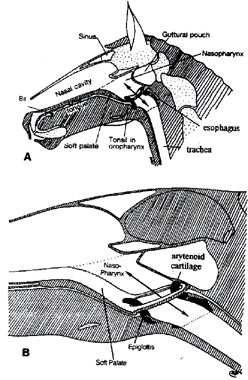
Fig 4. Relationship of soft palate
and larynx. At exercise, the larynx should fit tightly into a
‘button-hole’, the ostium intrapharyngium, in the soft palate.
There should be an airtight seal between the two so that no air
gets into the digestive tract, i.e., the oropharynx. If it does,
then the soft palate rises and starts to vibrate (Fig 8). One
way in which the seal can be broken is for a horse to be given
fast exercise with its poll in any position other than full
extension, something which is particularly likely to occur with
normal bit control (Fig 1b). Other ways caused by the bit
include the soft palate being dorsally displaced by root of
tongue mobility; by gag reflexes triggered by the bit; and by a
horse opening its mouth to evade the bit.
a). Neutral poll position (jowl
angle 87°):. Note the position of the bit in relation to the
tongue and soft palate. The double-ended arrow indicates the
direction of airflow.
b). Full poll extension (jowl
angle 150°): An enlarged and perspective view of the ideal
airway for galloping.
-
UPPER AIRWAY OBSTRUCTION
In normal horsemanship,
braking depends on using a bit to flex the poll. But without
poll extension, the horse is unable to breathe freely. The
governing of speed, therefore, is achieved at the expense of
respiration. This restriction varies from mild or moderate poll
flexion (e.g., in the rating of a racehorse) to severe poll
flexion (e.g., in the collection of a dressage horse). But even
mild obstruction of the airway is to be avoided in a racehorse,
as it handicaps performance and causes asphyxia-induced
pulmonary edema ("bleeding").2-4, 13 Similarly, the
performance of a dressage horse is not facilitated by partial
suffocation. The problem of headshaking5 in dressage
horses may often be caused by the bit.6-7
Although the atlanto-occipital
joint is capable of extension to produce a jowl angle of 150°
(Fig 4b), I have yet to find an action photograph of a
Thoroughbred racehorse with a jowl angle greater than 118° and
the average of 29 measurements was 103° (range 87°-118°).
The tongue and larynx are both
fixed to the hyoid apparatus (Fig 6). Any tongue movement
results in laryngeal movement and, at fast exercise, this
agitation of the airway would interfere with breathing. Airway
obstruction also occurs if the horse evades the bit by drawing
the tip of its tongue behind the bit ( Fig 7). Some abnormal
inspiratory noises at exercise can be eliminated, instantly, by
the simple expedient of removing the bit.
The soft palate lies on the root
of the tongue. Any movement of the tongue promotes the palate’s
dorsal displacement (Fig 7)8. The soft palate rises
during swallowing or coughing and this is perfectly normal but,
for unobstructed rapid breathing, it should be firmly depressed
(Fig 4)8.
My assumption is that in the
galloping horse, at liberty, the swallowing reflex will, like
the salivary and chewing reflex, be in abeyance. If, when at
racing speed (respiratory rate 120-140/min), a swallowing reflex
is invoked in a horse wearing a bit, the soft palate will rise
and be at risk of getting caught-up in the oscillating hurricane
blowing through the nasopharynx. Under these conditions,
displacement of the soft palate will persist. Dorsal
displacement of the soft palate is a normal function of
swallowing, not of rapid breathing (Fig 4).
If the racehorse with a bit in its
mouth is breathing too fast to swallow, saliva in the pharynx
cannot flow into the esophagus because the esophagus is closed.
Its only option is to flow into the larynx. Saliva, as we know,
is highly irritant to the laryngeal mucosa and precipitates in
us a paroxysm of coughing. In the galloping horse, if cough
reflexes are initiated, the soft palate will rise, and a choking
attack will follow.8,9 Alternatively, the irritation
may precipitate laryngospasm, which is an even more potent
source of suffocation.
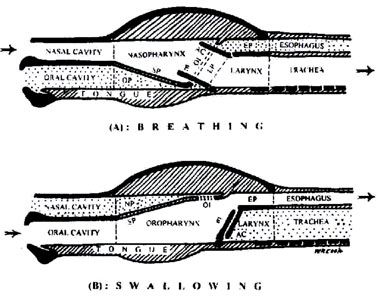
Fig 5. Showing the switching
processes needed to change pharyngeal function from exercising
to eating. For the sake of clarity, the mouth, oropharynx and
esophagus are shown as actual spaces. However, except for those
times when they contain food or liquid, these are - in normality
- potential spaces only.
Key: OI = ostium intrapharyngium;
E = epiglottis; AC = arytenoid cartilages; NP = nasopharynx; OP
= oropharynx; L = larynx; SP = soft palate; LP = laryngopharynx;
EP = esophageal pharynx
a). Exercising: The soft
palate is lowered to seal off the oropharynx and enlarge the
nasopharynx. The arytenoid cartilages are raised to close the
esophagus and open the larynx. The epiglottis is lowered to form
a seal with the soft palate and, more than is apparent in this
diagram, to smooth off airflow. The larynx now fits snugly into
the button-hole of the soft palate.
b). Eating dry food or
swallowing liquids: The soft palate is raised to close off
the nasal cavity and prevent food or water entering. The
arytenoid cartilages swing down to open the esophagus and close
the larynx, so preventing food or liquid from inundating the
lungs. Finally, the epiglottis swings back over the arytenoid
cartilages.
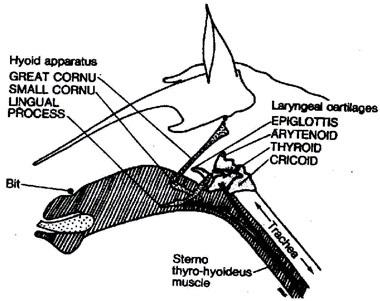
Fig 6. Showing how the larynx and
tongue are both suspended from the base of the skull by the
hyoid apparatus. As both share a common anchorage, any movement
of the tongue caused by the bit is likely to move the larynx,
which interferes with breathing.

Fig 7. The pathophysiology of
"swallowing the tongue". If the tip of the tongue is retracted
and comes to lie caudal to the bit, the root of the tongue
pushes the soft palate dorsally (obstructing the nasopharynx)
and the epiglottis caudally (obstructing the aditus laryngis).
The horse chokes-up and partially asphyxiates.
3. INTERFERENCE WITH GAIT
A cantering horse strides in time
with its breathing.10 As the bit interferes with
breathing, it also interferes with striding. Elimination of the
bit can do wonders for the gait of a horse. Its stride becomes
longer and its forehand lighter. Some of the natural grace of a
horse at liberty returns. Just as, in man, the most important
part of swimming is breathing so, in the horse, the most
important part of running is breathing.
-
SHORTER (SLOWER) STRIDES AND
RACETRACK BREAKDOWNS
The point of balance of a standing
and riderless horse lies on a vertical line just behind the 13th
thoracic vertebra. When the horse is mounted and in motion the
point of balance shifts cranially and the horse becomes heavier
on the forehand. One or more bits in the mouth further
contributes to this imbalance. First, the dead weight of the
bits, at the distal extremity of the head, shifts the point of
balance cranially. Secondly, because the rider is exerting and
often maintaining a pressure on the bit, this too adds
weight to the horse’s forehand. Thirdly, the horse tends to lean
on a bit. As soon as the bit is removed, its foreleg footfall
lightens, as can be demonstrated by listening to the soundtrack
of a video film.
A horse that is heavy on the
forehand has a shorter stride. The show horse develops a
‘choppy’ action and loses ‘self-carriage’. In the performance
horse, shorter stride means slower speed. Heavier forehand
concussion puts greater stress on the hard and soft tissues of
the forelegs. Racehorses are more likely to incur a breakdown.
5. RIGIDITY OF THE NECK AND LOSS
OF PROPULSION
Bit control results in many horses
‘resisting’ or ‘fighting’ the bit. The degree of resistance
varies from mild pulling to shoulder-aching tugging. In
addition, many riders use the reins to balance themselves in the
saddle. Drivers of harness horses, with lines (reins) that are 8
or 10 feet long have, if they wish, the ability to exert
tremendous leverage on the horse’s mouth.
Constant drag on the bit must lead
to bone ache in the mandible but also to a waste of energy in
locking-up the neck muscles. This neck brace effect does not
happen in the horse at liberty nor in the Thoroughbred when
ridden without a bit. Neither is rigidity of the neck compatible
with optimum athletic performance. Years ago, Rooney referred to
the fixation of the neck in Standardbreds, caused by overchecks
and head poles, which - in turn - he pointed out, results in
"irregular breathing."12 "Try running a few hundred
meters" he said "with your neck in a cast." No human athlete
could perform well without complete freedom of the neck.
A horse galloping at liberty, uses
the normal downward swing of its head and neck under the
influence of gravity as an aid to hind limb propulsion,
conserving energy by taking advantage of the elastic recoil in
the ligamentum nuchae.11 This phase of the gallop
takes place during expiration, when the forelimbs are weight
bearing. Rooney continues "…it appears that the more successful
racehorses have more movement of the head and neck than others."11
The gallop style of Secretariat, for example, was remarkable for
its unusual degree of head/neck mobility.11 I recall
that Secretariat was also a horse that refused to be rated;
hence his 15 length win in the Belmont. Perhaps Secretariat was
better than other horses at negating the bit?
A second energy saving device may
act on the forelimbs. As the head rises during inspiration, the
superficial fascia surrounding the brachiocephalic and
omotransversarius muscles will be tensed and this will pull the
forelimbs forward and help to overcome the inertia of their
momentary immobility at the end of expiration. This mechanism
adds further weight to the argument for avoiding restriction of
neck movement in the exercising horse.
-
ABNORMAL BEHAVIOR
Non-acceptance of the bit is so
common that its many forms have been given colloquial names.
Horses are described as ‘spitting the bit’, getting the ‘tongue
over the bit’, getting the tongue ‘behind the bit’, ‘lolling’
the tongue, incessantly moving the tongue, chewing or champing
the bit, sucking the bit, ‘getting the bit between the teeth’,
pulling, boring and leaning on the bit, crossing the jaws,
opening the mouth, foaming at the mouth, head tossing or head
shaking. Some of these items are illustrated in figures 7 - 10.
Other behavior modifications relate to many a bitted horse’s
aversion to exercise and to the gait modifications already
described. Evasion of the bit can be the sole cause of
inspiratory stridor at exercise, with air turbulence and
fremitus in the larynx that is detectable immediately after
exercise. Such episodes of ‘roaring’ can be differentiated from
recurrent laryngeal neuropathy by simply exercising the horse
again without a bit in its mouth.
Non-acceptance of the bit negates
control. Acute or chronic pain inflicted by the bit, impels a
horse to immobilize it by grasping it between the premolars.
Once this happens, the rider has no control and the horse may
bolt. Shakespeare describes it succinctly
"The iron bit he crushes
‘tween his teeth,
Controlling what he was
controlled with."
In recent years, tongue movement
and the ensuing dorsal displacement of the soft palate has led,
in Thoroughbred and Standardbred racing in the USA, to the
almost routine practice of tongue-tying and the addition of yet
another invasive foreign body in the mouth. Unlike
Thoroughbreds, the majority of Standardbreds race with two
bits in their mouth, a snaffle or curb and an overcheck bit.
This and other reasons already mentioned may well explain why
dorsal displacement of the soft palate is so common in
Standardbreds.
Upper airway obstruction, from
whatever cause, is - in my experience - an etiological factor to
be considered in the occurrence of racetrack breakdowns, choking
up, "bleeding" and sudden death. In view of this, the bit must
take its share of responsibility for these phenomena, alongside
the other more familiar causes such as recurrent laryngeal
neuropathy.13
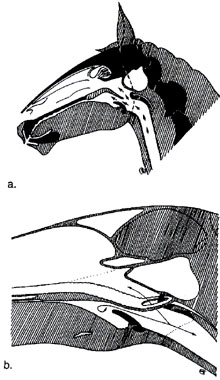
Fig 8. Companion figure to Fig 4,
showing the turbulent airflow that results when the soft palate
becomes dorsally displaced.
a). The arrows indicate how, once
the palate is raised, air enters the oropharynx at each
expiration. This maintains the problem until such time as the
horse can slow up and swallow.
b). An enlarged view of the throat
in Fig (a), showing the soft palate button-hole in perspective.
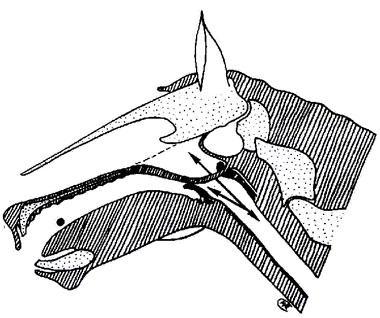
Fig 9. Showing how dorsal
displacement of the soft palate may occur when a horse opens its
mouth in response to bit traction, allowing air to enter the
oropharynx.
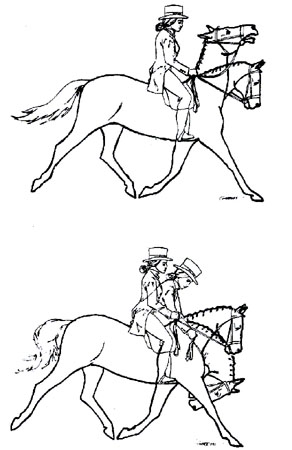
Fig 10. Showing the dorsiflexion
and ventroflexion of the neck described as head tossing or head
shaking.
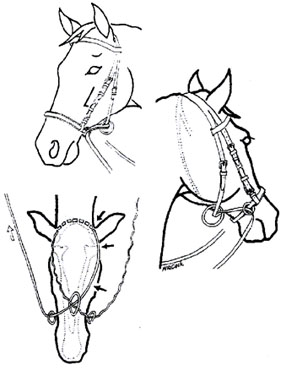
Fig 11. The design of the new
bitless bridle. The diagram bottom left is a ventral view of the
head and shows how, with transient traction on one rein, firm
but painless pressure can be applied to the poll, base of ear
and side of face. This bridle pushes, non-invasively and
painlessly, on skin, whereas a bit pulls, invasively and
often painfully, on the oral cavity.
7. ORAL AND DENTAL PROBLEMS
The horse is an obligatory
nose-breathing animal. At exercise, its lips should be sealed
and mouth closed, to prevent air entering the oropharynx and
causing soft palate displacement. Bit control breaks this ‘set’
of the lips and often opens the mouth.
The mouthpiece of a bit lies on
the tongue and diastema of the mandible, and the various rings
and shanks lie in contact with the delicate commissures of the
lips. The bit, therefore, is lying directly above the mental
foramen and the terminal branches of the mandibular nerve and in
contact with the exquisitely sensitive lips of an animal that,
left to its own devices, is fastidious about what it puts in its
mouth. In the past, I have not been able to put forward any
convincing explanation for the cause of headshaking in the
horse, and even less have I been able to suggest any
satisfactory treatment.5 But, from studying the
effect of the new bitless bridle (see below), I now recognize
that the bit is at least one cause of headshaking. Some horses
stop headshaking immediately the bit is removed.6
Headshaking may be a sign of trigeminal neuralgia brought on by
the persistent pressure of the bit. In man, "the fifth nerve is
often the seat of neuralgia"14 In the horse, local
pain in the mandibular branch of the nerve and referred pain in
the maxillary branch could well explain why some headshaking
horses rub their faces on anything handy and why some
headshakers get comfort from the pressure of a fly net over
their muzzle, or even from a maxillary (infraorbital)
neurectomy. It will be simple enough, in time, to put this
hypothesis to the test on a large number of headshakers.
Bit pressure causes contusion of
the gums, laceration of the tongue and lips, and star fractures
of the diastema.
A bit also lies close to any wolf
teeth that are present under the gum or just erupting through
the gum at a point in front of the first cheek tooth. Pain is
caused if the bit clashes up against or rolls over these
vestigial teeth. The cheek pieces of a snaffle and curb bridle
press the buccal mucosa against the sharp enamel edges of the
upper cheek teeth. Buccal ulceration is common. There is also
the problem of relying on a method of control that requires a
bit in the mouth of an animal whose permanent dentition is
erupting between the ages of two and five. Thoroughbred
racehorses are at the height of their careers during this
teething period.
If one asks a Thoroughbred or
Standardbred trainer what percentage of horses in their barn do
they expect at any one time to have mouth problems of one sort
or another, the answer ranges from 20 to 60%.
CONCLUSION
A bit is an unyielding foreign
body in a sensitive body cavity and is capable of causing pain,
injury, disease and even death. A bit in the mouth of an
exercising horse is physiologically contraindicated and, from
the rider’s point of view, counter-productive. The wonder is
that all horses do not resent the bit. It is possible, however,
that we may not be recognizing signs of bit discomfort in many
horses. Much improvement in performance might be gained, even in
a horse that is thought to be untroubled by the bit, by its
removal. This step can certainly be an enormous relief, for
example, to the headshaking horse6.
It takes a little study to realize
that simply removing a piece of metal from a horse’s mouth
provides more effective and safer control; helps the horse to
breathe and move better; and improves its whole attitude to
work. Horses prefer bridles "with a bit missing".14
Riders and drivers need to be
aware of the constraints that a bit places on the horse’s
natural functions. The less horsemen depart from what is
natural, the less will they generate man-made problems for the
horse and themselves. As a horse can be more safely controlled
without a bit and as this brings benefits to both horse and
rider, these are compelling reasons to re-evaluate the bit’s
time-honored place in equitation.6 Competition
regulations for some sports that currently make use of a bit
obligatory will, it is hoped, be modified in future.
As has been convincingly
demonstrated in recent years, the bitless option is available by
adopting the methods of natural horsemanship for all the
early stages of schooling.1 But for the more refined
control needed at the stage of advanced schooling, even the
natural horseman currently resorts to the use of a snaffle bit1.
This last step can now be avoided because refined control can be
effectively provided by the recent introduction of a
fundamentally new design of bitless bridle. This is neither a
mechanical hackamore nor a bosal, both of which rely for their
effect, as does the bit, on poll flexion. Instead the new bridle
works by painless pressure on skin behind the ear; probably
acting on a cluster of acupressure points in this region (Fig
11). It permits humane, effective, and non-invasive control
without interfering with respiration or locomotion6,7.
An inoffensive bridoon snaffle can be hung from the bitless
bridle in such a way as to comply with current competition
regulations yet still retain many of the new bridle’s
advantages.
Acknowledgments
Many of the author’s diagrams were
first published in previous articles. They are reproduced by
permission of the editors of the Veterinary Record, the
Proceedings of the American Association of Equine Practitioners,
and Equine Practice.
REFERENCES
-
Parelli, P:
Natural Horse-man-Ship.
Western Horseman Inc., 1993
-
Cook, W.R: Williams, R.M.,
Kirker-Head, C.A. and Verbridge, D.J:
Upper airway obstruction
(partial asphyxia) as the possible cause of exercise induced
pulmonary hemorrhage in the horse: an hypothesis.
J Equine Vet Sci, 8:11-26, 1988.
-
Cook, W.R:
Exercise-induced pulmonary
hemorrhage in the horse is caused by upper airway obstruction.
Irish Veterinary Journal, 46:160-161, 1993.
-
Cook, W.R:
EIPH or AIPE.
Equine Athlete March/April 1997, p23
-
Cook, W.R:
Headshaking in horses: An
afterword.
Compendium on Continuing Education for the Practicing
Veterinarian, 14:1369-1376, 1992.
-
Cook, W.R:
Use of the bit in horses.
Vet Rec. 142: 16, 1998
-
Cook, W.R:
Use of the bit in horses.
Vet Rec. 142: 676, 1998
-
Cook, W.R:
Some observations on form
and function of the equine upper airway in health and disease,
Part I: The pharynx.
Proc Am Assoc Equine Pract. pp 355-392, 1981.
-
Cook, W.R:
Some observations on form
and function of the equine airway in health and disease, Part
II: The larynx.
Proc Am Assoc Equine Pract. pp 393-452, 1981.
-
Cook, W.R:
The diagnosis of respiratory
unsoundness in the horse.
Vet Rec 77:516-528, 1965.
-
Rooney, J.R:
The normal vertebral column,
in The Lame Horse,
The Russell Meerdink Co., Neenah, WI, 1998
-
Rooney, J.R:
More on bleeding.
Equine Veterinary Data ..: -34, 1981?
-
Cook, W.R.
Speed in the Racehorse: The
Airflow Factors,
The Russell Meerdink Co., Neenah, WI, 1993
-
Pick T.P.and Howden R:
Gray’s Anatomy,
Descriptive and Surgical.
15th English edition, p738. Bounty Books, New York,
1977
-
Bonner, J:
Changing Tack; horses may
prefer bridles with a bit missing. New Scientist, p16,
4 July 1998
|