|
|

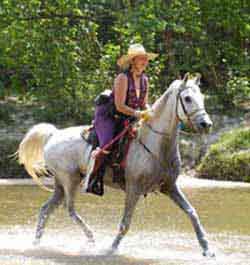
Darolyn riding 'Chasar'
DAROLYN BUTLER-DIAL ON BAREFOOTIN'
'BAREFOOTIN' happens to be my most favorite subject in the
world...right up there with "Endurance Riding". In fact, it seems my life
now is ridin', trimmin', or talkin’ about one or the other.
We maintain about 50 horses at Cypress Trails Equestrian Center in Humble
(near Houston), Texas. Our focus and obsession is Endurance, but since not
one of us has figured out how to make a living at it, my horses have to work
for a living. Approximately 10 of those 50 are board horses & 1/2 of those
help their owners make a living (along with our personal horses), by serving
as riding horses for the daily trail rides that we serve the public with.
Oh... did I mention that each and every one of these horses is barefoot.
They all live outside with other horses and they all manage to get their
feet immersed in water every day. Those are the three requirements for
successful barefooting. The correct physiological trim, living naturally &
feet immersed in water, (similar to the wild horses going into ponds &
streams to drink).
Now if you had told me prior to September 2000, that I would even consider
leaving a competing Endurance mount barefoot, running a 50 miler, or ohmygosh, a 100 miler, I would have told you that you
were absolutely insane!!!!
"How it all Started"
On Sept. 19th 2000 a reigning National Champion Endurance horse that I was
riding a 100 miler on "plunked out" at 80 miles. He was in excellent shape,
it was flat terrain, it was hot, but he was used to it. I asked the vet (my
request) to give him fluids to make him feel better, which he did, but the
next day he started showing definite signs of laminitis. What was going on?
Having witnessed, through my own horses, and horses of friends, this
insidious disease, and having watched at least 8 of those so afflicted
horses progressively grow worse and be put down, I panicked! In retrospect
and knowing what I know now, my theory is that most horses, and especially
this one, develop a mild case of laminitis every time they compete on hard
terrain in shoes. In this horse’s case he had run 4-5 competitions in the
previous 5 months, shod and on hard terrain. Eventually, the laminae simply
could not take it anymore. This also explains the rings that we see on our
horse’s feet at the appropriate time interval after a tough competition,
weather change, feed change or health change.
I rushed the horse to the best veterinarian hospital in Texas, (IMO) and two
weeks later, even though all the medicinal heroics had been applied,
(including heart bar shoes), the horse was abscessing and worse. Enter a web
page (actually 4 of them); I read until the wee hours of the morn, for four
days straight. Convinced I had found the answer, I had my new farrier remove
the heartbar shoes and do his best to do a natural trim from the directions
I had printed off the Internet.
Two strokes of luck, (1) one of my boarders had a copy of “Lifetime of
Soundness” by Dr. Hiltrud Strasser, and shared it with me, (2) a few days
later, I located a Houston couple that had been nursing a severely foundered
Friesian they had imported in early 1999. They had actually gone to Canada
and spent two weeks with Sabine Kells, (the only "Strasser Certified Hoof
Specialist" in North America at the time), to learn the trim.
Their horse had "sole penetration" and everyone, including more than one
veterinarian was encouraging them to put the horse down. July 2002, fast
forward... this horse was at my barn, sound, showing off for Dr. Strasser,
during a Hoof Clinic there. The only signs of previous founder being the
telltale scars of the bedsores on the prominent bony areas. His owners were
kind enough to assist and coach us in the initial trim of my champion horse.
The laminitic horse came sound... he ran his 1st race in January, four
months after the attack. He almost won his 2nd race, and did win his third,
“barefoot of course”. Oporto & Bronze Star ran 80 out of 100 miles barefoot
in February 2001 of that year. Several other farm horses ran the 50 &
25-mile races. In April both of them ran a 100 at the same sight (sans the
rocky road) & successfully completed. Granted, my heart was in my throat
those first few races. The veterinarians were shaking their heads in
disbelief. The horses hadn't even been de-shod a whole year... but it was
working.
I still laugh at my early attempts to trim. I never intended, at 50 years of
age, and with a much too busy a schedule already, to take on a new skill of
this magnitude. However, my husband had just had rotary cuff surgery and my
main wrangler and barn manager was away in Brazil for a month of Christmas
holiday. So, when Ms. Martha Olivio came to my place to do a clinic on
December 19, 2000, I picked up a hoof knife for the first time in my life.
She stayed in our area over Christmas Holidays, and visited my place several
times, so I had the unique advantage of her ongoing presence that most new
trimmers don't. By December 29th, (with Martha’s help) almost every horse on
our place was de-shod. One boarder’s horse, which had an incredibly high
club foot, was taken "way!!!!" down, and ran a 50 mile race 10 days later,
boy was I nervous. Bronze Star, my mount, was only trimmed the Thursday
before running on Saturday and would have won if his silly rider (me) hadn't
missed a trail marker early on. We still placed 2nd. I must admit, the
ground there was ideal, mainly pastures & dirt roads, but still... could
their feet take it?
During the summer of 2001 a friend’s horse developed severe laminitis, I was
asked to help. I felt extremely naïve. Luckily, Dr. Strasser (with Sabine
Kells) was conducting one of her rare U.S. clinics in Florida. I went. Since
then I’ve sponsored or attended one other clinic with Dr. Strasser, one with
Todd Merrell and a couple with Martha Olivio. Along with reading the “big
blue” book, (Strasser’s Hoof Care Specialist’s Handbook) and watching my own
horses de-contract, come sound and become healthier, my education in
“Natural Living for Horses” soared. By the way, the incidence of colic in
our heard has reduced by 2/3rds. And best of all, the friends’ horse
recovered nicely in 60-90 days with no other history of problems.
“Changes in Older Horses”
Oporto and Chasar (17 yrs), (who holds the Arabian Jockey Club record for
the most starts by an Arabian in flat tract racing), had lived most of their
lives in a stall. Oporto because he was a stallion until recently & Chasar
lived at the racetrack. He came off the track and became an Endurance horse
at the age of 12 years, the age most horses are considering retirement.
If either of theses horses lost a shoe and it was not replaced immediately,
their feet would crumble and the farrier would have to use acrylic or like
matter to build their feet back to hold a shoe. You can read Chasar's story
about his trip (barefoot) to the 2001 World Cup in Dubai, UAE, in the Horses
Hoof, and Oporto carried me to the Pan American Championship in Vermont,
September 2001.
Now... to let you know that I'm not foaming at the mouth "barefootin' or
nothing"... I chose to shoe for the Pan American,
September ‘01. It was very rocky ground and due to a devastating flood in
June - in which I lost Bronze Star - my proposed effort to travel and train
in rocks that summer before was impossible. Nonetheless, I don't think
Oporto would have been the sound horse that he was, if he had not been
spending the majority of his time "Barefoot".
He had a badly contracted foot, due to an early age injury, which caused him
to unweight that foot. Every time we had any kind of a lameness issue,
(which was often); it was on the "high foot" leg. Even though I knew he was
an incredible athlete, I hated to waste a lot of time and energy
conditioning due to the doubtful leg. By lowering that heel, through the
"barefoot trim" the foot started decontracting and he became sounder than he
had ever been in his life.
I found myself competing a little less aggressively on some occasions at
first, as the motto of our sport received an addendum ...."To Finish
Barefoot, is To Win". It was a great mental and physical victory all rolled
into one. If you would have told me prior to year 2000 I would even attempt
to ride a 100 miler barefoot, I would have laughed in your face.
Now please understand... this is a personal choice. I truly feel I am doing
the right thing for the horse. I'm increasing his longevity and health, in
my opinion. I am trying different boots, and hoof protection when rocky
grounds require it. I truly believe we are the cutting edge of a total shift
in the belief system of the horse’s health. They will develop better and
more useable hoof protection than the steel shoe. The public will demand it,
and it will happen as all supply/demand things do.
Its pretty easy to see our successes and failures, by just looking at my
records in the American Endurance Ride records.
www.aerc.org All my horses, plus some I have sold, start with DJB. If the
rides are not exceptionally rocky, they are going
“Barefooted”. Yes, you will find pulls on occasion, a few barefoot related,
but most were caused by other problems or “rider
error”.
Here’s a sampling of results 2 /12 have years later. We had 15 out of 16
Barefoot Farm horses finish a hot challenging ride in July 2001. The one
pull was an old tendon injury. Eight of the top ten were Barefoot, others
besides my own.
Chasar won Foxfire 50 in September ‘02, and Razz won & BC'd at Armadillo in
October, both “Barefoot”. Razz had a pretty bad case of laminitis in the
fall of 1996. I had determined I would always ride him with full pads to
protect his very flat and tender feet. I felt that once a horse had
laminitis, he was at high risk for a second attack. After 3 years of natural
trimming, his feet are now regaining some degree of concavity, and he and
the other two "bad footed" horses have the thickest walled, and purtiest
feet "ya ever did see". Razz’s biggest “barefoot” victory to date was
finishing all but 35 miles of the Ft. Howes 100 Mile Endurance Ride
“barefoot” while winning the ½ Arab IAHA National Championship in 2002.
Now for 2003, in August two different horses won first and Best Condition
both days on a merciless hot Texas ride. The first day 50, (the hottest), I
won over an hour over the 2nd place horse. The winning horse, DJB Tiffany,
was bought out from under the noses of the killers at a local sale barn in
early 2002. Even another “barefooter” deemed her feet a wreck, due to old
scars and such, and didn’t think she would ever hold up to Endurance Riding.
She’s awesome, even though her career is young, (however she’s 13) she has
performed on gravel roads, and shown incredible speed and stamina in
competition.
In October we finished 5 farm horses 3rd, 4th, 5th, 6th, & 7th in the
Armadillo 100 on one of the toughest 100 mile courses we have tackled
barefoot to date. What a victory!
I've competed in International rides since 1985. I have over 25,000 miles of
competition behind me, several National
Championships, FEI Medals, and one Gold from the World Nature Games. My
competition horses each have their own custom fitted saddle, they are fed a
special custom blended feed, they are wormed and inoculated on a regular
schedule, but they are not pampered or coddled.
They now make my living for me, and my wonderful husband (of three years.)
If my horses’ feet are bad, they don't work, if they don't work they are
useless to me. I have not made this choice lightly. I have read both of Dr.
Strasser's books multiple times. When I started in 2000, I had a limited
anatomical background. I had to learn from scratch. I'm still learning and
self-educating. I asked for the "Big Book" for Christmas of 2001, got it,
read it, read it again, and now refer to it regularly. Now when I look at a
high heeled, contracted foot, I cringe. I know what that foot is supposed to
look like.
What’s interesting, is the thing most people say when they finally become
familiar with the natural trim, is. "It's so logical, I always hated to put
nails in my horse’s feet." And yes folks, the horses hate the shoes. I’ve
seen their faces after a good “barefooted” horse is shod. It’s very sad and
uncomfortable.
I encourage all people, especially women, to learn the trim to take control
of their lives and not be held at bay by farriers that don't show up, or
don't fix the problem. No one really knows their own horse better than them.
If owners will educate themselves to know what to look for, (a balanced foot
isn't that hard to understand), they can fix the little things on a daily or
weekly basis, (which can be done only if the foot is bare), then presto, you
have a happy, sound, and balanced animal. Which is what we all want, right?
I reiterate other "barefoot proponents" however, when I say, it is not for
everyone, on some occasions, I'm sad to say, its not for me, due to my
"soft, sandy living conditions", and I'm forced to shoe for that occasional
"rocky" ride. However, there are two or three “hoof protection boots” on the
drawing board, which I hope will soon eliminate the use of shoes forever.
March 2004 I just completed a 10 Day Hoof Groom Course with Martha Olivio.
She has created a “Map” of the horse’s foot that makes trimming and
understanding the natural hoof so very much easier than ever before. So if
one is willing to attend a clinic, read some books, and practice, practice,
practice, “The Trim”, there is no reason anyone can’t become a competent
hoof care person. There’s lots of clinics out there now.
If you are not willing to perform the "three requirements", it normally
won't work. (1) Correct Trim (2) 24/7 Turn-Out (3) Feet in water regularly.
Look how it will simplify your life and learn how it will increase the
quality and longevity of your horse. Please, if you consider
yourself an intelligent and caring horse owner, read "Lifetime of Soundness"
and read some of the case histories on the web pages before you are too
quick to judge.
If you decide to do your own trimming, buy the well priced Dick Knives
(about $20), keep them sharper than sharp. Get a rolling stool to sit on for
trimming, REALLY! A good foot stand, and t-fal rasp... oh.. Don’t forget the
gloves & the leather apron. What an empowerment for a horse owner,
(especially a female) to be able to judge your horse's feet, and do whatever
balancing or therapy is needed. No more interference, forging, losing shoes,
waiting on farriers, etc.!!!
As touted by Dr. Strasser, Chris Pollitt, and Dr. Bowker of Michigan state,
the hoof plays a much bigger role in the overall health of the horse than
most of us have ever realized.
Darolyn Butler
Dare (to Be Bare) Barefooted That Is!
Darolyn Butler-Dial & Mark Dial
CYPRESS TRAILS EQUESTRIAN CENTER & HORSEMAN VIDEO SHOWCASE
Proven Endurance Horses for Sale or Lease.
Adventure Trail Rides * Boarding * Training*Lessons *Parties
Represents: Sharon Saare Saddles, Professional Choice, Advanced Biological
Concepts, & KM (Human Electrolytes)
ADVOCATE :THE WHOLE HORSE TRIM (Barefootin")
21415 Cypresswood Dr. Humble, Texas 77338
Ph: 281 446 7232 Fax 281 446 0113 Toll Free (800) 228 8768
e mail: darolynj@earthlink.net <mailto:darolynj@earthlink.net
>
Web Page Cypress Trails:
www.horseridingfun.com
Here are Darolyn’s personal thoughts on the next ten years of horse keeping.
TEN YEAR PREDICTIONS For THE BAREFOOT MOVEMENT
(Written Summer of 2002)
Ten years from now, I predict a good many farriers will not only be doing
the "barefoot trim", but tout that they always supported it.
Ten years from now, I predict most upscale vets will have a "Natural
Trimmer" on the payroll to quickly assist navicular, club
footed, laminitic and foundered horses.
Ten years from now, I predict 95% of all "back yard pleasure horses" will be
kept barefoot.
Ten years from now, I predict cutters, reiners, roping, barrel, and race
horses will be allowed the choice of performing barefooted, and as more and
more of them win money, and have longer performance careers, the field will
grow.
Ten years from now, horse museums will house metal atrocities called
therapeutic shoes on their walls, and people will look at them in disgust
and amusement that man could have been so ignorant of how the foot actually
works, that they would attempt to cure those ills with shoes, knowing what
nature could heal much quicker and better left on its own.
Ten years from now, 10,000 trimmers will have saved 1,000,000 horses from
retirement and/or death by giving them healthy feet.
Shoeless, Not Clueless!!!
Darolyn Butler-Dial * 25,000 Endurance Miles
50 Barefoot Horses Working & Playing Everyday
DAROLYN JANE BUTLER – Biography
21415 Cypresswood Dr.
Humble, TX 77338
Ranch phone: (281) 446 7232
Darolyn started riding before she could walk, and cried when taken off
horses as a toddler. Even though there was no such thing as Endurance Riding
in her native state of Oklahoma in the 1960’s, she claims to have been born
to do just that. Early years found her riding for hours and hours, exploring
the countryside on and near her family’s farm and ranch. She was soon active
in horse shows and barrel racing, as that was the thing to do in Oklahoma in
the ‘60’s & 70’s. A stint as Miss Rodeo Oklahoma, (she also won the
Horsemanship Division in the Miss Rodeo America pageant), and a job as Miss
Ford Country, (a cowgirl advertising campaign for Ford Motor Co.), gave her
another boost in the equine direction.
In 1972 she was Crowned Miss Oklahoma State University and after graduating
from there, she represented Tony Lama Boot
Company in East Texas and Southern Louisiana, which spurred her relocation
to the Houston, Texas area. Horse shows and
rodeos still filled her spare moments until she discovered Endurance Riding
in 1981. A short year later, all the performing quarter horses had been
replaced by Arabians and cross-Arabs, the breed of choice for endurance
riding.
Her previous experience with horses served her well as she moved into the
ultimate sport of Endurance Riding with devoted
enthusiasm. Endurance is normally a one-day event (much like a human
marathon), of distances from 25 to 100 miles. The
famous Tevis Cup Ride, (considered the toughest ride in the world), was her
third Endurance Ride, and she won her first of several National
Championships in 1984. With the change in her horse sport came a career
change also. She became the owner and producer of Horseman Video Showcase. A
premier video production company that specialized in producing equine
training videos and equine product promotionals. With more than two dozen
instructionals under her belt, including her own “Long Distance Riding”
video and the top selling equine instructional of all time, John Lyons
“Round Pen Reasoning”, she produced 8 Issues of Horseman Video Magazine, and
nearly 40 thirty minute television shows entitled, The Horse Show.
Her daughter Rima was born in 1979, and in 1982, she was joined by sister
Cecilia, and, as they became old enough, joined their mother, as she
continued her hobby/obsession of Endurance Riding. She gives clinics and
private instruction on her favorite sport, competes Internationally, and has
won Team and Individual medals of Gold, Silver and Bronze, in the U.S. and
abroad. One of her greatest thrills was winning the Gold Medal and Best
Condition at the World Nature Games in Parana, Brazil in 1997.
In 1995 she acquired her Texas Trainer’s License and has intermittently
trained Arabians and a few thoroughbred racehorses for the racetrack. Her
heart remained with the Long Distance horses however. Then in 1994, after
rebuilding her home and
Cypresswood Stables, following a devastating flood of 15 feet depth, she
gave in to the public who continually asked to rent horses from her very
visible farm, near Humble, Texas. Now, she combines the business of giving
Adventure Trail Rides and lessons, with conditioning, training, buying, and
selling only the Long Distance Racehorses.
In 1998, she and her great mare DJB Albanet finished 7th and Best Condition
in the grueling Old Dominion 100-Mile Ride.
1999 was truly an Endurance year as she ran 12
Texas races in the first 6 months of the year, finished Tevis in late July,
traveled to Canada for the Pan American Endurance Championship in early
August & had her 2nd Top Ten finish at the Cosequin Challenge in Virginia on
September 18.
In November 1998, Darolyn was invited to present a 6-day clinic on Endurance
at THE UNIVERSITY OF THE HORSE, near Sao
Paulo, Brazil. Then in December 1998, she took off for the World Endurance
Championship in the United Arab Emirates, where she served as Chef d’Equipe
for the Romanian Team, whose rider finished 54th from a field of 175
competitors. She capped off 1998 by winning the National Middleweight 100
Miles Series Championship on Albanet.
Brazil has a special appeal to Darolyn. November 1999 she has been invited
to race in the Brazilian 10th Anniversary of Endurance Riding. This trip
will be even more special, as it will also serve as her honeymoon following
her marriage to Mr. Mark Allen Dial.
Year 2000 found her competing in the Presidents Millennium Cup in UAE, a
member of USET’s Team at the World Championship in France, and returning to
the UAE for the World Cup in March 2001. Vermont was the next International
stop as Darolyn was a member of the Silver Medal winning team at the Pan
American Championship. In September ’03 she was part of the Central Time
Zone Team in the Pan American.
Darolyn’s mileage continues to accrue, as she is at the 25,000-mile mark in
her competitive riding. She actively gives lessons and clinics, as she
introduces all ages to the thrill of horseback riding and Endurance
competition.
Career Highlights: American Endurance Ride Conference & FEI INTERNATIONAL
RACE & CAREER HISTORY
2003 - Team Member - Central Time Zone Team - Pan American Championship
2003 - Reached 25,000 Miles of Competition Level
2003 - 2nd Place in the FEI Biltmore Challenge 100 Mile Race
2002 - Became Licensed FEI Steward
2002 - Speaker and clinician at Equine Affair, W. Springfield, Ma.
2001 - One of 3 U.S. Riders selected to ride in the United Arab Emirates
World Cup
2001 – Team Member Central Time Zone - Pan American Championship
2000 - 4th Place - President’s Millennium Race - Abu Dhabi, UAE
2000 - Team Member of the U.S. Equestrian Team World Championship – France
1999 - Pan American Endurance Championship - Central Time Zone
1999 - Completed Western States Trail Ride “Tevis Cup”
1999 - Top Ten Finish Cosequin Challenge
1999 - 4th Place Indiv. – 1st Team Race of Champions - Brazil
1998 - Top Ten Finishes in Old Dominion & Cosequin Challenge
1998 - World Endurance Championship – Chef d’Equipe Romania
1998 - National Middle Weight Champion on Albanet
1997 - Central Region Best Condition - 3rd Central Middleweight
1997 - Gold Medal in World Nature Games – Parana, Brazil
1996 - Assist. Chef’d’Equipe for Chile World End. Race
1996 - Furnished 6 Horses for foreign riders for World Race
1996 - 1st place Mare in Race of Champions
1995 - 2nd Middleweight Cen. Region / Best Condition Cen. Region
1995 - Top Ten National 100 Mile Award/ 5th Ntl. Family Award
1994 - Top Ten Central in Weight Division & Best Condition
1993 - 1st Central Region Middleweight & 7th Overall Outlaw 5 Day
1992 - 1st Alternate for USA World Team
1991 - Silver Medal Team - North American Championship
1991 - 3rd Ntl. Middleweight. / 1st Central Region Middleweight
1990 - National Bill Thornburg Family Award - Central Middle. Wt 1st Place
1989 - National Middleweight Champion on “Baskhatrino”
1988 - Supplied 3 mounts to foreign riders for World Championship
1988 - Top Ten in Husband/Wife Team & Family Award
1987 - Team Gold, Individual Bronze in North American Championship
1986 - Silver Medal Team - North American Championship
1986 - Ntl. Champ & Reserve Best Condition on “Thunder Road”
1985 - Represented USA in Austria for 1st European International Competition
1984 - National Champion & Best Condition on “Karram Rou Fad”
1981 - Completed Western States Trail Ride “Tevis Cup” ( 3rd ride ever, 1st
100)